Most people don’t quit strength training because they lack motivation. They quit because the plan feels confusing, overly intense, or built for someone far beyond the beginner stage. We can avoid that trap by focusing on a few repeatable movements, manageable workouts, and steady progress.
A beginner strength training routine does not need complicated equipment or daily gym sessions. It needs a realistic schedule that trains the major muscle groups, gives your body time to recover, and leaves you feeling capable enough to come back for the next session.
What Makes a Beginner Plan Work
The best first program is almost never the hardest one. It is the one we can perform consistently while learning good form, building tolerance for training, and fitting exercise into a normal week of work, family, errands, and sleep.
Federal activity guidance recommends muscle-strengthening work for all major muscle groups on at least two days per week. The same guidance notes that one set of 8 to 12 repetitions can be effective for building strength, although additional sets may deliver more benefit as we gain experience. Physical Activity Guidelines for Americans (niddk.nih.gov)
Here is the simple framework we recommend:
| Training element | Beginner target | Why it matters |
|---|---|---|
| Weekly sessions | 2 full-body workouts | Builds consistency without overload |
| Exercises per session | 5 to 6 movements | Covers major movement patterns |
| Repetitions | 8 to 12 per exercise | Balances control and challenge |
| Sets | 1 to 3 | Allows gradual progression |
| Rest between sets | 60 to 120 seconds | Supports better technique |
This approach is intentionally modest. In 2024, only 26.4% of U.S. adults met both aerobic and muscle-strengthening activity guidelines, according to Healthy People 2030 data. A plan that feels sustainable is more valuable than a perfect-looking plan we abandon after two weeks. Healthy People 2030 (odphp.health.gov)
The Movements We Need to Practice
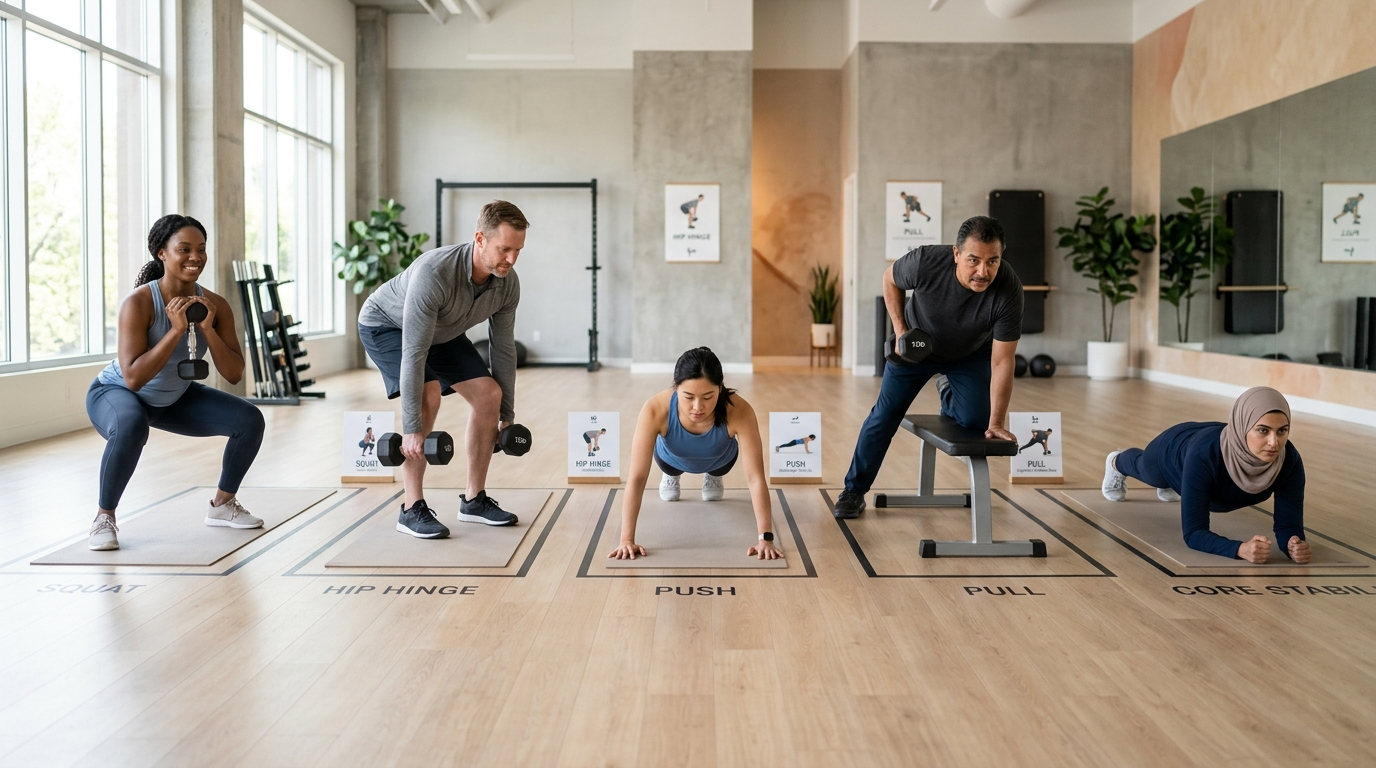
Rather than chasing dozens of exercises, we can cover the whole body with a handful of foundational patterns. Use body weight, resistance bands, dumbbells, machines, or a mix of them. The best equipment is the equipment we can use safely and consistently.
Squat or Knee-Dominant Movement
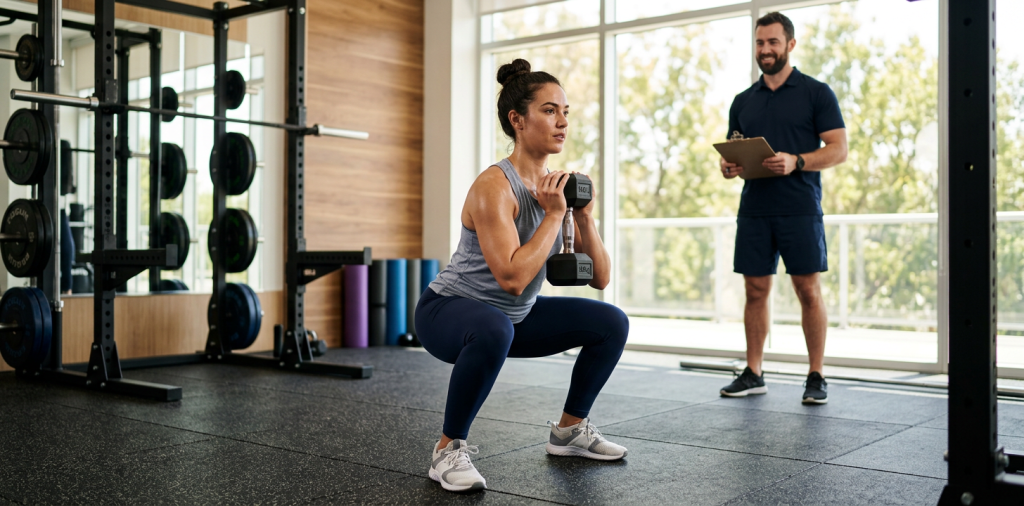
Examples include a body-weight squat, goblet squat, leg press, or sit-to-stand from a sturdy chair. These movements train the thighs, hips, and core while making everyday activities, like standing up or climbing stairs, feel easier.
Hip Hinge
A dumbbell Romanian deadlift, hip hinge with a dowel, glute bridge, or hip thrust teaches the hips to produce force while the torso stays controlled. Start light and prioritize a smooth range of motion over depth or load.
Push
Choose an incline push-up, chest press machine, dumbbell bench press, or overhead press. Keep the movement controlled and stop a repetition when posture begins to slip.
Pull
A seated cable row, resistance-band row, dumbbell row, or lat pulldown balances pressing work and trains the upper back. Think about pulling your elbows toward your ribs rather than yanking the weight with your arms.
Core Stability
Planks, dead bugs, bird dogs, and suitcase carries are excellent beginner choices. The goal is not to make your abs burn at all costs. It is to help the trunk stay steady while the arms and legs move.
Your Beginner Strength Training Routine
Perform Workout A and Workout B on nonconsecutive days, such as Monday and Thursday. Begin every session with five to 10 minutes of easy movement, such as walking, cycling, marching in place, or gentle mobility work.
Workout A
- Goblet squat or chair squat: 8 to 12 repetitions
- Incline push-up or chest press: 8 to 12 repetitions
- Dumbbell or cable row: 8 to 12 repetitions per side
- Glute bridge or Romanian deadlift: 8 to 12 repetitions
- Dead bug: 6 to 10 controlled repetitions per side
Workout B
- Reverse lunge or leg press: 8 to 10 repetitions per side
- Dumbbell overhead press: 8 to 12 repetitions
- Lat pulldown or resistance-band row: 8 to 12 repetitions
- Hip thrust or light Romanian deadlift: 8 to 12 repetitions
- Front plank or elevated plank: 15 to 30 seconds
For the first two weeks, perform one set of each exercise. During weeks three and four, move to two sets if you are recovering well. In weeks five through eight, complete two or three sets for most movements, depending on time, energy, and comfort with your technique.
The final few repetitions should feel challenging but controlled. We should usually finish each set feeling like we could still perform two or three good repetitions. That leaves room to learn, recover, and return stronger rather than grinding through sloppy reps.
How We Progress Without Rushing
Progressive overload simply means asking the body to do slightly more over time. It does not require a dramatic jump in weight every week.
Use this progression order:
- First, make the movement smoother and more consistent.
- Next, add repetitions until you reach the top of the recommended range.
- Then, add a small amount of weight or choose a slightly harder variation.
- Finally, add a set only if recovery, schedule, and technique are all solid.
For example, if we complete goblet squats with 15 pounds for 8 repetitions, keep that load until 10 to 12 repetitions feel controlled. Then increase the weight by the smallest available amount and return to the lower end of the repetition range.
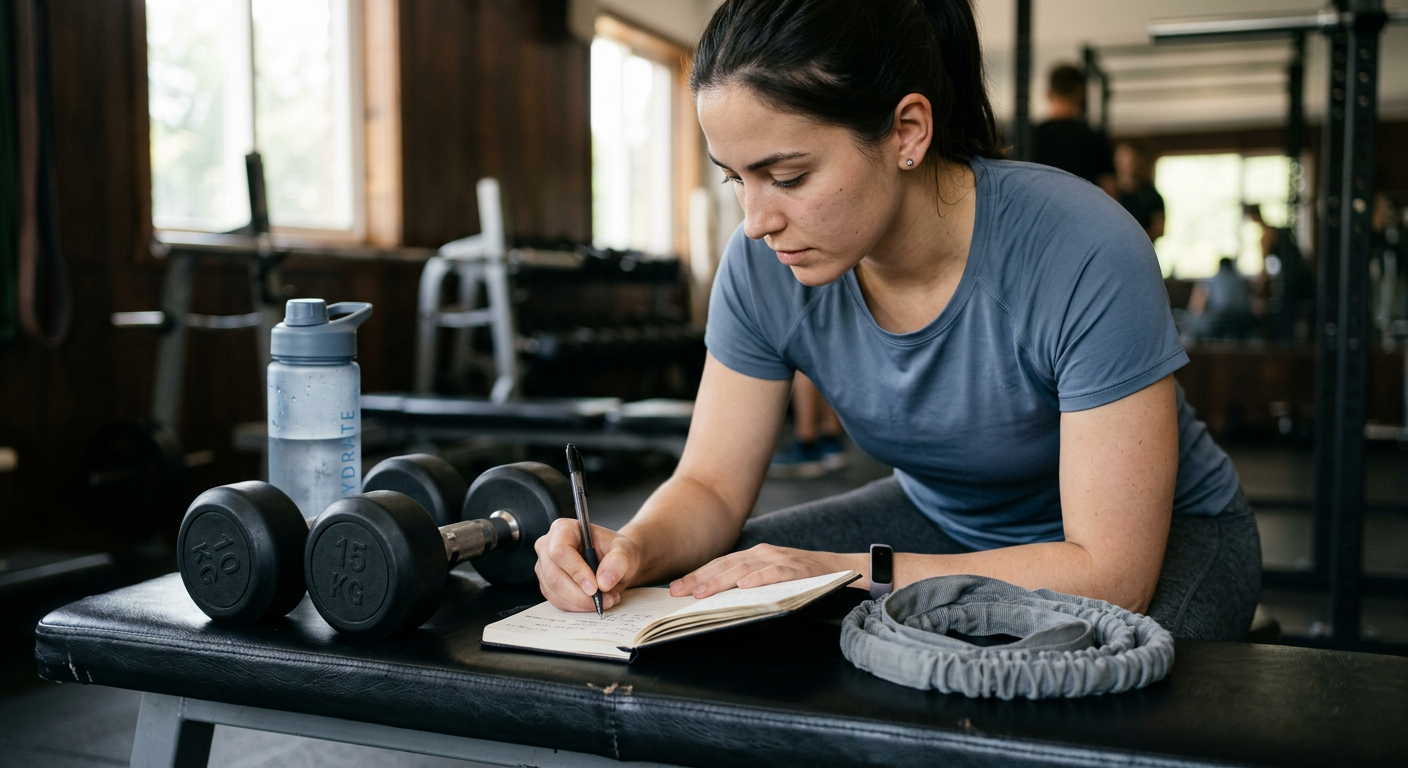
Keeping a short training log makes this much easier. Record the exercise, load, repetitions, and a quick note about how it felt. Small wins become visible, which is especially helpful when physical changes take longer to notice.
Form, Recovery, and Safety Matter More Than Sweat
Soreness is not the scorecard. Mild muscle soreness can happen when we begin, but sharp pain, joint pain, dizziness, chest discomfort, or pain that changes how we move are signals to stop and get appropriate medical guidance.
The CDC notes that moderate activity is safe for most people, while people with chronic conditions, disabilities, or long periods of inactivity should discuss suitable activity types and amounts with a clinician. CDC guidance for adding physical activity (cdc.gov)
Recovery also supports results. Aim for at least one day between strength sessions, eat regular meals with enough protein and overall energy, and protect your sleep routine. Training is the stimulus, but recovery is where we adapt.
Common Beginner Mistakes We Can Skip
Trying to train six days per week
More workouts do not automatically create better results. Two high-quality full-body sessions can build a strong foundation, especially when we are still learning exercise technique.
Changing the program every session
Variety can be enjoyable, but too much of it makes progress difficult to measure. Stay with the core routine for at least six to eight weeks, adjusting only when an exercise causes pain or clearly does not fit your equipment.
Using weights that are too heavy
Heavy weight is not a shortcut to strength. A lighter load moved with control helps us build confidence, practice positions, and recognize what appropriate effort feels like.
Ignoring aerobic activity entirely
Strength work and cardiovascular activity support different parts of health. Adults are advised to accumulate at least 150 minutes of moderate-intensity aerobic activity weekly alongside muscle-strengthening work on two or more days. CDC adult activity guidance (cdc.gov)
Questions Beginners Often Ask
How many days a week should beginners lift weights?
Two nonconsecutive full-body sessions per week are enough to begin. After several consistent weeks, we can add a third day if we enjoy training, recover well, and have time to maintain it.
Can we build strength with body-weight exercises?
Yes. Squats, incline push-ups, glute bridges, split squats, planks, and rows using a resistance band can provide an effective starting point. We progress by adding repetitions, slowing the tempo, improving range of motion, or moving to a tougher variation.
How much weight should we use?
Choose a load that lets us complete the target repetitions with steady control and two or three repetitions still in reserve. If we cannot maintain form for at least eight repetitions, reduce the load or simplify the movement.
Should we feel sore after every workout?
No. New training can cause mild soreness, but it is not required for progress. Consistent sessions, gradual progression, and adequate recovery matter far more than chasing fatigue.
Is a gym necessary for a beginner workout plan?
No. A pair of adjustable dumbbells, resistance bands, and a sturdy chair can support a productive home program. A gym becomes useful when we want more equipment options, machine support, or a dedicated training environment.
When should we increase the weight?
Increase the load when we can complete the top of the repetition range with strong form across all planned sets. Use the smallest available increase, then rebuild repetitions gradually.
Build a Health Routine You Can Keep
We believe fitness information should make healthier decisions feel practical, not intimidating. Visit Content Beast for more evidence-based ideas on fitness, sleep, habits, mindfulness, personal finance, and everyday well-being that fit real life.
The Strongest Start Is the One We Repeat
A successful beginner strength training routine is not defined by exhaustion, expensive gear, or complicated programming. It is defined by two or three well-planned sessions each week, fundamental movements performed with care, and small improvements that accumulate over time.
Start with the routine above, keep the first month manageable, and track the lifts that matter. In eight weeks, we are far more likely to feel stronger, more confident, and ready for the next step because we built the habit before trying to maximize the outcome.