Starting strength work does not require a crowded gym, punishing soreness, or a complicated spreadsheet. The best beginner strength training routine is one we can repeat consistently, learn safely, and make slightly harder over time.
For most new lifters, full-body training two or three times per week is the most efficient place to begin. A 2026 American College of Sports Medicine review synthesized 137 systematic reviews involving more than 30,000 participants and found that regular resistance training improves strength, muscle size, physical function, balance, and more. The message was refreshingly simple: consistency matters more than complexity. Read the ACSM summary
The Eight-Week Plan at a Glance
This routine builds the movement skills that matter most: squatting, hinging, pushing, pulling, carrying, and bracing the trunk. We can do it at home with dumbbells and a resistance band, or use comparable machines at a gym.
| Phase | Weekly sessions | Sets per exercise | Main goal |
|---|---|---|---|
| Weeks 1 and 2 | 2 | 1 | Learn form and build the habit |
| Weeks 3 and 4 | 2 | 2 | Build confidence and tolerance |
| Weeks 5 through 8 | 3 | 2 | Add steady strength progress |
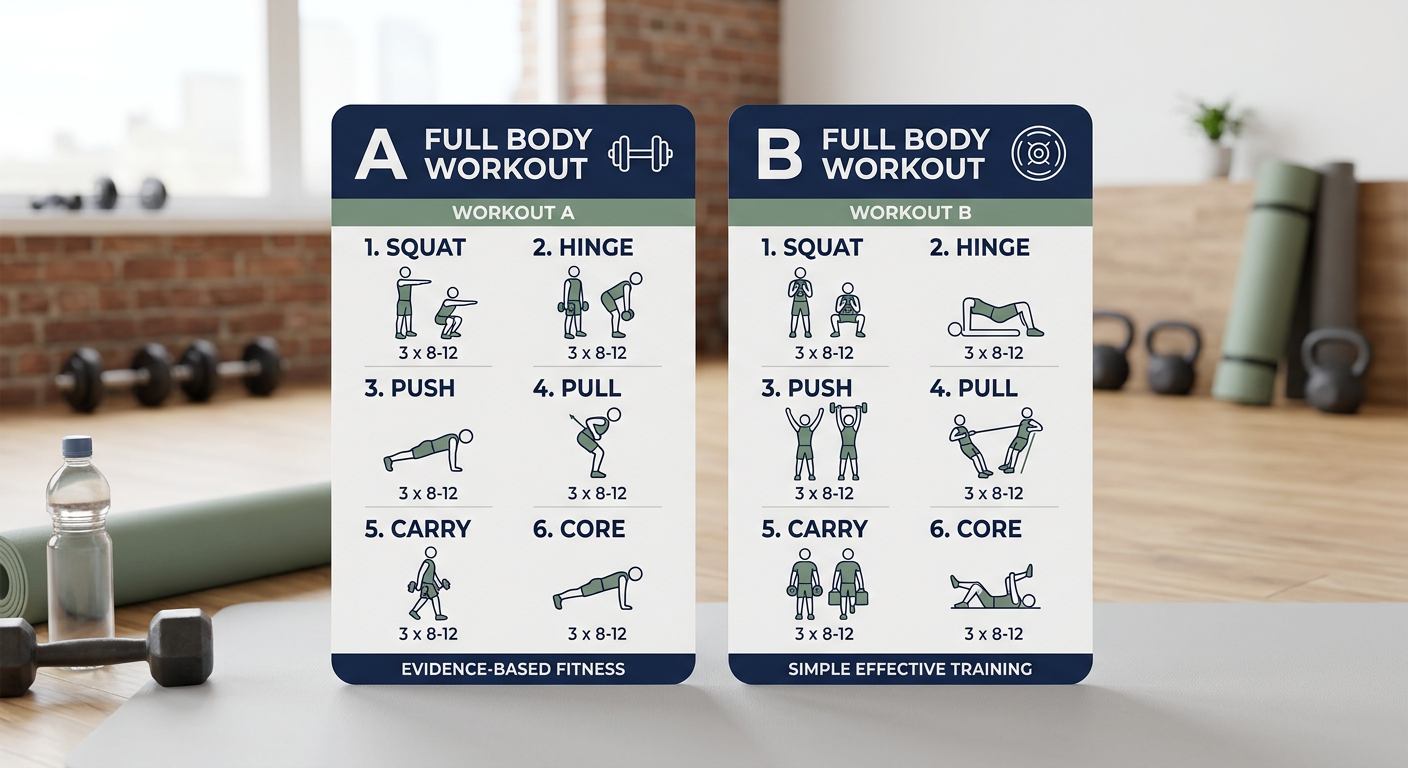
Leave at least one rest day between sessions. If we train twice weekly, use Workout A on the first day and Workout B on the second. If we train three times weekly, rotate A, B, A in week one, then B, A, B in week two.
Start With Weights That Let Us Learn
The right starting weight feels controlled, not effortless and not intimidating. We should finish each set feeling that we could complete roughly two more good repetitions before our technique begins to change.
That buffer gives us room to learn. We do not need to train to exhaustion to make early progress, and chasing soreness can make it harder to show up for the next workout. The ACSM review also found that equipment type and training to momentary fatigue did not consistently change outcomes for the average healthy adult. Review the full research summary
Before each session, take five minutes to prepare: walk briskly, cycle easily, climb stairs, or perform gentle bodyweight versions of the first two exercises. The goal is to feel warmer and more mobile, not tired.
Workout A: Squat, Push, Pull, and Carry
Workout A gives us a straightforward full-body session with movements that transfer well to ordinary tasks like standing from a chair, carrying groceries, and lifting a bag from the floor.
Goblet Squat or Chair Squat
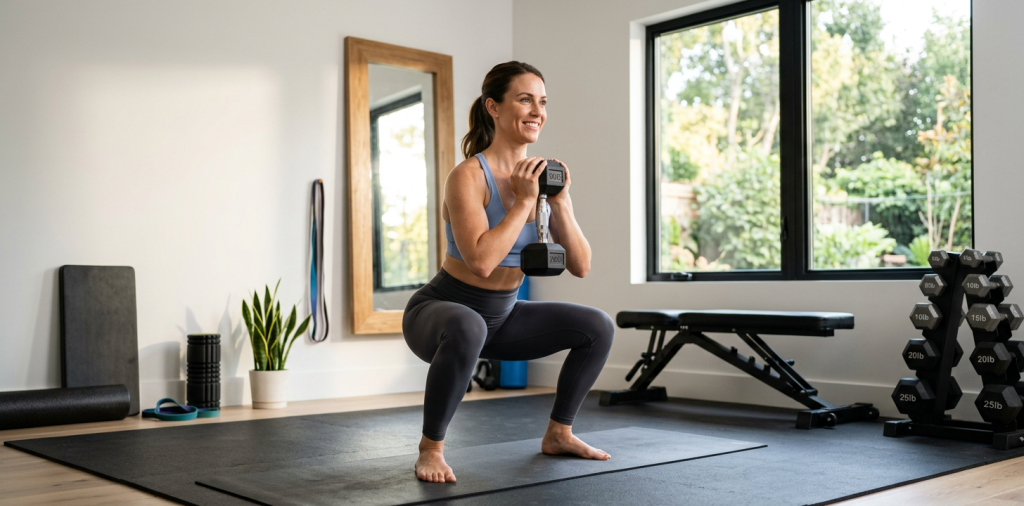
Complete 8 to 10 repetitions. Hold one dumbbell close to the chest for a goblet squat, or begin by sitting down to a chair and standing back up with control.
Keep the feet about shoulder-width apart, let the knees track in the same direction as the toes, and keep the chest comfortably tall. Lower only as far as we can maintain control and avoid pain.
Incline Push-Up or Dumbbell Floor Press
Complete 8 to 12 repetitions. For incline push-ups, place the hands on a sturdy counter or bench. For a floor press, lie on the floor with dumbbells held above the chest and lower them slowly.
An incline makes the push-up easier to control, which is why it is often a better starting point than forcing standard floor push-ups. As we get stronger, we can use a lower surface.
One-Arm Dumbbell Row or Band Row
Complete 8 to 12 repetitions on each side. Support one hand on a bench, chair, or thigh, then pull the weight toward the hip without twisting the torso.
Think about moving the elbow back rather than shrugging the shoulder toward the ear. A stable body position matters more than using a heavier dumbbell.
Glute Bridge
Complete 10 to 12 repetitions. Lie on the back with bent knees, press the feet into the floor, and lift the hips until the body forms a comfortable line from shoulders to knees.
Pause briefly at the top, then lower slowly. This is a beginner-friendly way to train the hips and hamstrings before progressing to more demanding hinge patterns.
Suitcase Carry
Walk for 20 to 30 seconds on each side while holding one dumbbell like a suitcase. Stand tall, take slow steps, and resist leaning toward the weight.
Carries build grip, trunk stability, and confidence with loaded movement. They are also easy to scale by adjusting the weight, distance, or pace.
Workout B: Hinge, Press, Pull, and Brace
Workout B complements the first session by teaching us to move from the hips and control the upper body through a slightly different angle. Use the same deliberate pace and stop each set before form slips.
Dumbbell Romanian Deadlift
Complete 8 to 10 repetitions. Hold dumbbells in front of the thighs, soften the knees, and send the hips backward as the weights travel close to the legs.
We should feel tension in the back of the thighs, not strain in the lower back. Keep the spine neutral, pause when the hamstrings limit the range, then stand by driving the hips forward.
Seated Dumbbell Shoulder Press or Machine Press
Complete 8 to 10 repetitions. A seated position reduces the urge to arch the lower back and helps us focus on a smooth overhead press.
Use a range that feels comfortable through the shoulders. If overhead pressing causes pain, substitute an incline dumbbell press or chest press machine.
Lat Pulldown or Band Pulldown
Complete 8 to 12 repetitions. Pull the bar or band toward the upper chest while keeping the ribs from flaring upward.
Avoid yanking the weight or leaning far back. A slower return phase teaches control and makes a lighter load feel more productive.
Split Squat With Support
Complete 6 to 8 repetitions on each side. Hold a wall, rail, or chair for balance, take a staggered stance, and lower straight down within a comfortable range.
This movement improves leg strength one side at a time. If it feels too unstable at first, repeat chair squats instead and revisit split squats after two weeks.
Dead Bug
Complete 6 to 8 slow repetitions on each side. Lie on the back with knees above hips, gently press the lower back into the floor, then extend the opposite arm and leg without losing that position.
This is not about moving fast. It is about learning to brace the trunk while the arms and legs move.
Use Progressive Steps Instead of Chasing Perfect Workouts
The best results come from a routine that develops in manageable stages. For our Day 2 approach, we build on the first habit rather than replacing it with a harder plan every week.
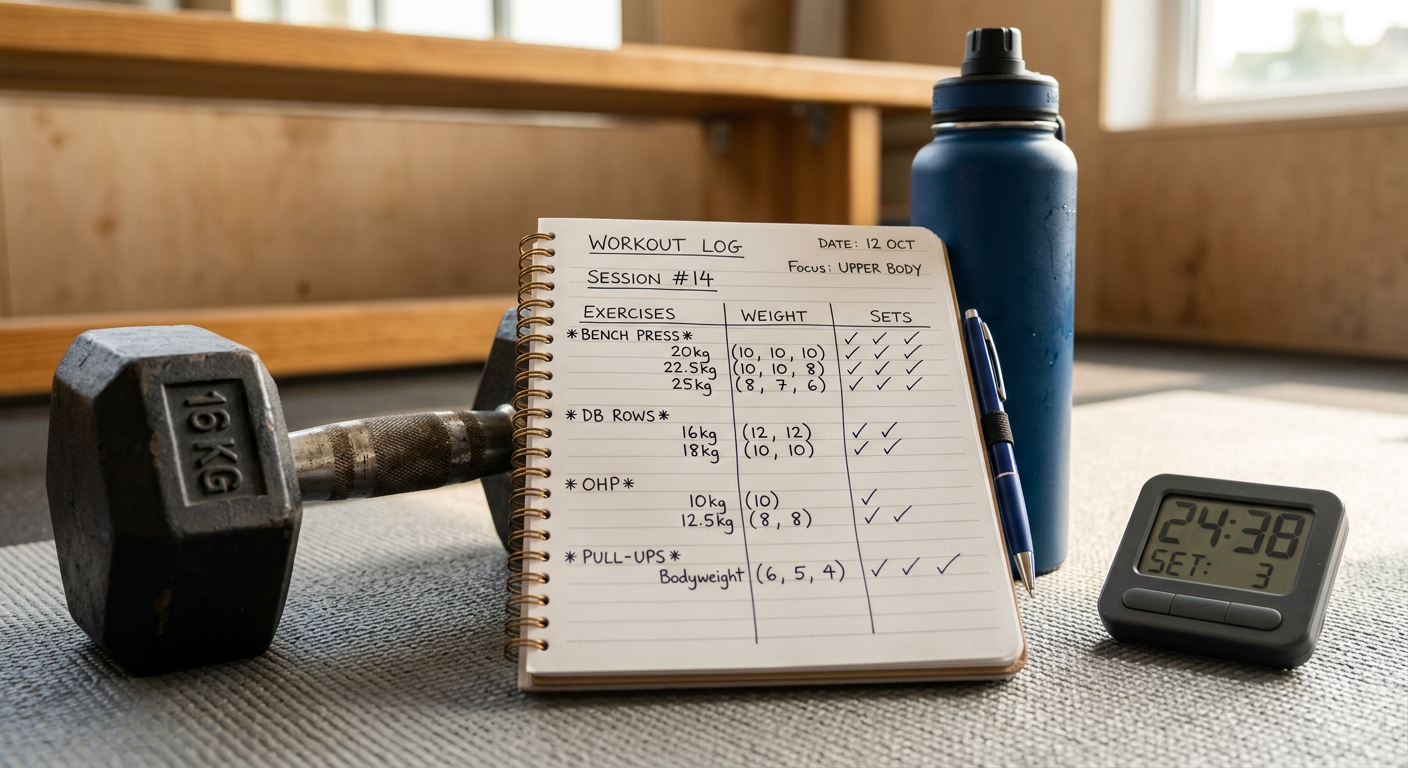
During weeks one and two, we do one set of each movement and write down the exercise, weight, and repetitions. In weeks three and four, add a second set while keeping the same load if necessary. From week five onward, add the third weekly session only if recovery, sleep, and daily energy feel steady.
Progress one variable at a time:
- Add one or two repetitions while keeping clean form.
- Add a small amount of weight after reaching the top of the repetition range in every set.
- Use a slightly more challenging variation, such as a lower incline for push-ups.
- Improve the range of motion only when it remains pain-free and controlled.
For example, if we complete two sets of 12 goblet squats with a 15-pound dumbbell and could still do more with excellent form, the next session might use a 20-pound dumbbell for eight repetitions. That is progressive overload without unnecessary complexity.
Recovery Is Part of the Routine
Strength gains happen between workouts as the body adapts to training. Rest days are not missed opportunities, they are part of the plan.
Aim for regular sleep, enough food to support activity, hydration, and light movement such as walking on non-lifting days. Mild muscle soreness can be normal when we begin, especially a day or two after a new movement. Sharp pain, joint pain, swelling, dizziness, chest discomfort, or symptoms that feel unusual are reasons to stop and seek appropriate medical guidance.
If we have a medical condition, recent surgery, uncontrolled blood pressure, a history of heart symptoms, or significant joint limitations, a clinician or qualified exercise professional can help tailor a safe starting plan. There is no prize for forcing an exercise that does not fit our current body or experience.
Common Beginner Mistakes to Avoid
Beginners usually do better by doing less, consistently, than by trying to copy advanced routines. These adjustments protect motivation and make progress easier to measure.
Changing the Plan Every Week
Use the same core exercises for at least four to eight weeks. Familiar movements make it easier to see whether strength, balance, and control are improving.
Adding Weight Before Owning the Movement
A heavier dumbbell is useful only when we can still control the full repetition. If the back rounds, the shoulders pinch, or momentum takes over, reduce the load or shorten the range.
Treating Rest as a Failure
Two quality workouts each week can produce meaningful progress. The 2026 ACSM guidance emphasizes training all major muscle groups at least twice weekly, not spending every day in the gym. See the updated recommendations
Ignoring the Logbook
Memory is unreliable after a busy week. A simple note on a phone with the exercise, load, repetitions, and how the session felt is enough to guide the next workout.
Questions Beginners Commonly Ask
Do we need a gym to build strength?
No, we can build strength at home with bodyweight movements, dumbbells, resistance bands, or a sturdy backpack. A gym can provide more equipment options, but the most useful setup is the one we can use consistently.
How long should a beginner strength workout take?
Plan for about 35 to 50 minutes, including the warm-up. Early sessions may be shorter because we are learning movement positions and resting as needed.
Should beginners lift heavy or use light weights?
Start with a load that lets us complete the planned repetitions with solid control and about two repetitions still available. Weight can increase gradually as movement quality and confidence improve.
Can we do cardio while following this routine?
Yes. Walking, cycling, swimming, and other cardio can fit well on rest days or after shorter lifting sessions. Keep the overall workload realistic so the strength sessions still feel recoverable.
What if we miss a workout?
Resume with the next planned session instead of trying to cram two workouts into one day. A missed session is normal, and a routine succeeds because it is flexible enough to survive normal life.
When should we change to a more advanced program?
Consider a new plan after eight to twelve weeks if we have built consistent training habits, learned the core movements, and can no longer progress with the current exercise variations. A more advanced plan should add purpose, not just more volume.
Build Strength by Keeping the First Step Small
A strong beginning is not defined by how sore we are or how much weight we lift in the first month. It is defined by showing up, practicing the major movement patterns, recording small improvements, and recovering well enough to return.
Use this routine for eight weeks, adjust exercises when pain or access requires it, and focus on one small improvement at a time. That approach builds a foundation we can use for stronger muscles, steadier energy, and more confidence in everyday movement.
Keep Building Better Habits With Us
If we are also creating useful health, fitness, or lifestyle content for an audience, ContentBeast can help turn reader questions into organized, search-friendly articles. Explore the platform to build a consistent publishing rhythm without losing the clarity and usefulness readers expect.