A strong home workout routine does not begin with an expensive rack of weights or a punishing schedule. It begins with a small, repeatable plan that helps us learn a few useful movements, practice good form, and build confidence without making exercise feel like another full-time job.
If we are wondering how to start strength training for beginners at home, the answer is refreshingly simple: train the major movement patterns twice each week, make the exercises challenging but controlled, and add difficulty gradually. The latest guidance from the American College of Sports Medicine reinforces that consistency matters more than complicated programming, and that bodyweight moves, bands, and home-based workouts can build strength and improve physical function.
A 2026 ACSM evidence review synthesized 137 systematic reviews representing more than 30,000 participants. Its practical message is ideal for newcomers: moving from no resistance exercise to a sustainable routine creates the biggest early win.
Your At-Home Strength Training Plan at a Glance
| Element | Beginner Target | What We Need | Simple Rule |
|---|---|---|---|
| Frequency | 2 full-body sessions weekly | Clear floor space | Rest at least one day between sessions |
| Session length | 25 to 40 minutes | Timer or phone | Stop before form breaks down |
| Exercises | 5 to 6 movements | Bodyweight, backpack, bands | Train legs, push, pull, core |
| Sets and reps | 2 sets of 8 to 12 reps | Notebook or notes app | Make the final reps feel challenging |
| Progress | Small weekly adjustment | Patience | Add reps before adding load |
Start With the Right Goal and a Small Setup
The best early goal is not “get ripped” or “lift heavy.” We can aim to complete two home strength sessions each week for four weeks. That target is specific, realistic, and valuable because it builds the habit that makes every later result possible.
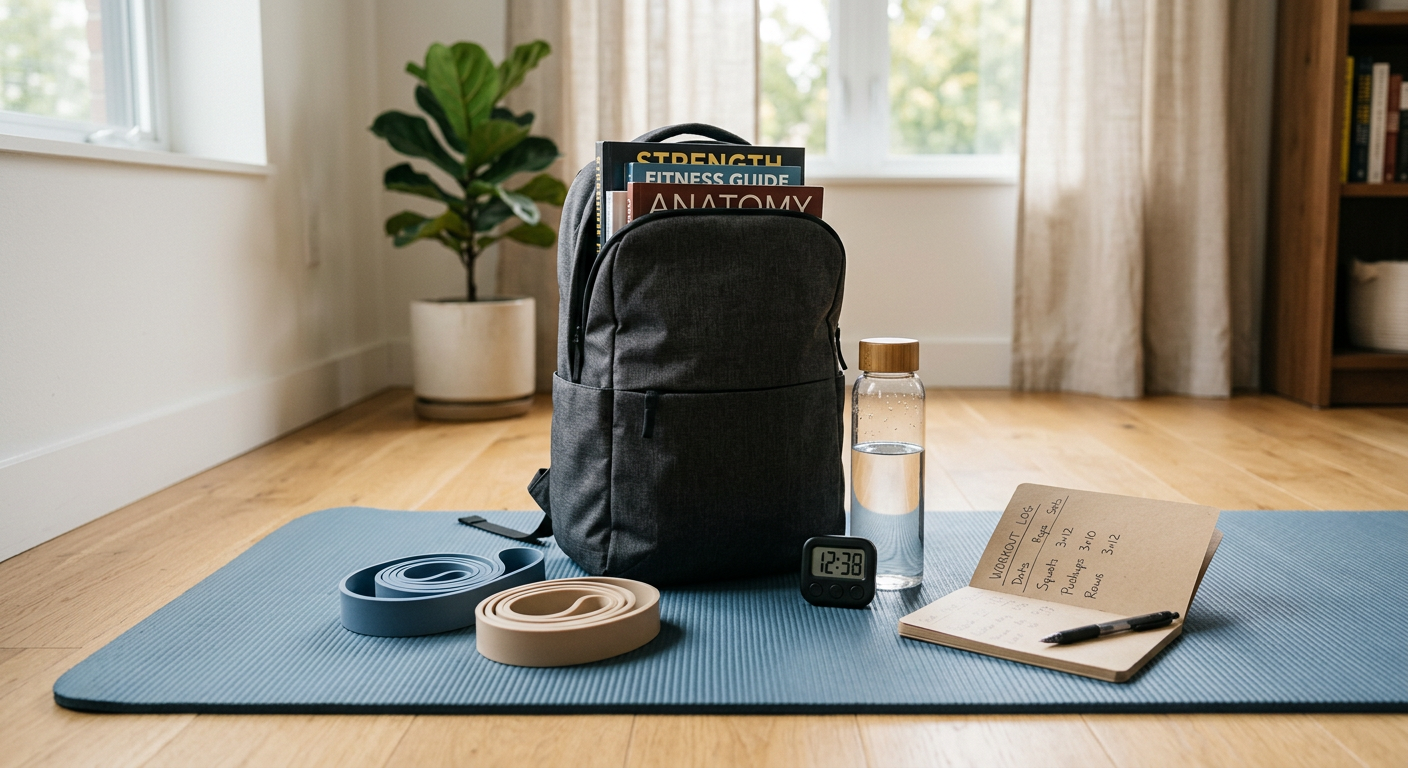
Create a training area that removes friction. We only need enough clear floor space to lie down with our arms out, a stable chair or couch edge, and a surface that will not slide. A backpack loaded with books or water bottles can become a useful weight, while a long resistance band is an inexpensive upgrade when we are ready for more variety.
Choose a time you can protect
Morning, lunch break, or after work can all work. What matters is attaching training to something that already happens, such as changing into comfortable clothes after work or brewing morning coffee. Put the sessions on the calendar like appointments, then keep the first month uncomplicated.
Use the talk test for effort
Strength sessions should feel focused, not frantic. During each set, we should be able to breathe steadily and maintain control, but the last two or three repetitions should require real effort. If we could easily do ten more reps, the movement is probably too easy. If our posture collapses or we hold our breath, it is too difficult.
How to Start Strength Training for Beginners at Home Safely
Before the workout itself, we need a few guardrails. Mild muscle soreness after an unfamiliar session can be normal, but sharp pain, joint pain, dizziness, chest discomfort, or numbness are not signals to push through. We should stop and speak with a qualified healthcare professional when those symptoms occur.
If we have a recent injury, uncontrolled medical condition, are pregnant, or have been advised to limit activity, personalized medical guidance comes first. Good training should make daily life feel more capable, not leave us worried about our next movement.
Warm up for five minutes
We do not need an elaborate mobility ritual. Spend five minutes moving through a comfortable range of motion: march in place, circle the arms, perform easy hip hinges, do a few shallow squats, and gently rotate the upper back. The goal is to feel warmer and more coordinated before the working sets begin.
Learn these six movement patterns
Most effective beginner routines include a squat, hinge, push, pull, single-leg exercise, and core stability movement. These patterns train the major muscle groups without requiring a huge exercise list.
- Squat: chair squat or bodyweight squat for thighs and glutes.
- Hinge: backpack Romanian deadlift for glutes and hamstrings.
- Push: wall push-up, incline push-up, or knee push-up for chest, shoulders, and triceps.
- Pull: resistance-band row for upper back and biceps.
- Single-leg work: supported split squat or step-up for balance and leg strength.
- Core stability: dead bug or plank for trunk control.
The ACSM review notes that home-based resistance exercise, elastic bands, and bodyweight training can improve strength and physical function. That matters because it lets us focus on the quality of our practice instead of waiting until we have a perfect gym setup.
A Beginner Full-Body Workout We Can Repeat
Complete this session twice per week on nonconsecutive days. On the first day, move slowly and learn the positions. It is completely fine to perform one set of each exercise during week one, then build to two sets as the routine starts to feel familiar.
The workout
-
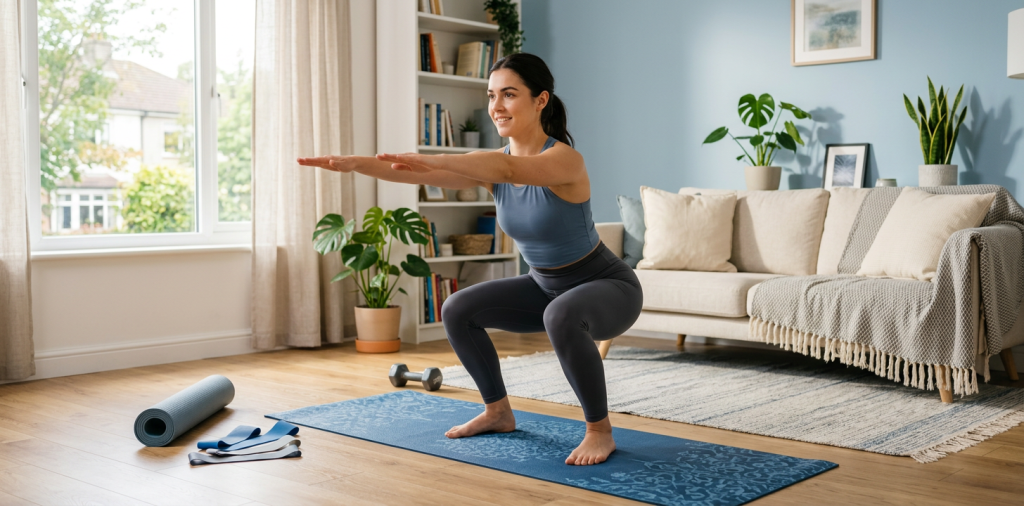
Chair squat: 2 sets of 8 to 12 repetitions. Stand in front of a sturdy chair, sit back with control, lightly touch the seat, then stand tall. Keep the knees tracking in the same direction as the toes.
-
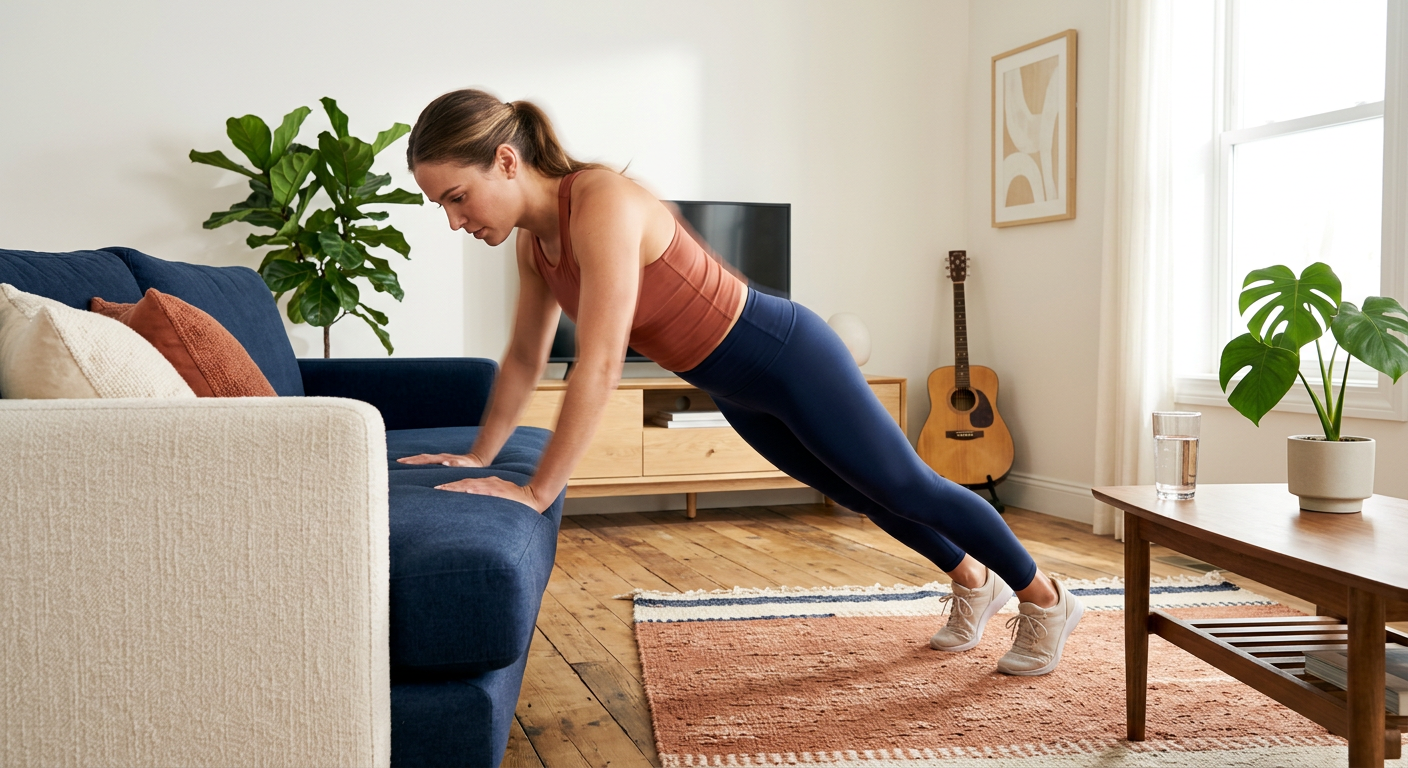
Incline push-up: 2 sets of 6 to 12 repetitions. Place hands on a counter, sturdy table, or couch edge. Keep the body in a straight line as we lower the chest toward the surface and press away.
-
Backpack Romanian deadlift: 2 sets of 8 to 12 repetitions. Hold a loaded backpack close to the legs. Soften the knees, push the hips back, and keep the back long as the backpack moves down the thighs.
-
Resistance-band row: 2 sets of 8 to 15 repetitions. Secure the band only around a stable anchor designed to hold it. Pull elbows toward the ribs, pause briefly, and avoid shrugging the shoulders upward.
-
Supported split squat: 2 sets of 6 to 10 repetitions per side. Hold a wall or chair for balance, lower only as far as we can control, then push through the front foot to stand.
-
Dead bug: 2 sets of 6 to 10 repetitions per side. Lie on the back with knees bent, brace the abdomen gently, and lower the opposite arm and leg without allowing the low back to arch.
Rest for about 60 to 90 seconds between sets. We do not need to take every set to complete exhaustion. Leaving a couple of controlled repetitions in reserve is a smart way to learn form, recover well, and come back ready for the next session.
Progress Without Making the Routine Complicated
The first few weeks are about repetition, not perfection. Track the exercise, resistance used, and number of reps in a notebook. That simple record helps us see progress that can otherwise be easy to miss.
Use the double-progression method
Begin within the recommended repetition range. When we can complete the top number of reps for every set with steady technique, make one small change next time. Add a few books to the backpack, choose a lower incline for push-ups, use a stronger band, slow the lowering phase, or add one extra set.
For example, if we complete two sets of 12 chair squats comfortably, we might switch to a slower three-second lowering phase. Once that feels solid, we can hold a light backpack. Small changes add up while keeping the workout approachable.
Recover like training matters
Strength improves between workouts, not only during them. Aim for consistent sleep, regular meals with protein, and easy movement such as walking on rest days. We do not need a flawless nutrition plan, but adequate food and rest make it far easier to practice good form and remain consistent.
Common Beginner Mistakes We Can Avoid
Trying to do too much too soon is the classic problem. A workout that leaves us unable to sit down comfortably for a week is not proof of success. It is usually a reason the habit disappears.
Avoid changing the routine every session. Keep the same core exercises for at least four weeks so we can practice technique and measure improvement. Variety can be enjoyable later, but repetition creates skill.
Also, do not confuse sweat with strength progress. A controlled set of squats, rows, and push-ups may feel less dramatic than a fast circuit, yet it is often more useful for building the movement quality and progressive challenge that beginners need.
Frequently Asked Questions
Do we need dumbbells to begin strength training at home?
No. Bodyweight exercises, a loaded backpack, and resistance bands are enough for a productive beginner routine. Dumbbells are convenient, especially adjustable ones, but they are not a requirement for building a consistent base.
How many days per week should beginners strength train?
Two nonconsecutive full-body sessions per week are an excellent starting point. This matches the commonly recommended minimum of training the major muscle groups on at least two days weekly, while leaving room for recovery and normal life.
How long does it take to notice progress?
We may feel more coordinated and confident within a few sessions. Strength changes often become clearer over several weeks as we add repetitions, improve control, or use more resistance. Take note of performance wins, not just changes in the mirror.
Should beginners train until muscle failure?
No. We can make progress without pushing each set until we cannot complete another repetition. Stopping while technique remains solid is usually more practical for learning movements and staying consistent at home.
Can strength training help with weight management?
It can support a broader weight-management plan by improving strength, preserving or building muscle, and making active living easier. Still, body-weight changes are influenced by food intake, sleep, stress, activity, health conditions, and many other factors, so we should avoid treating one workout plan as a magic solution.
What if a movement hurts our knees, shoulders, or back?
Stop the painful movement and do not try to “work through” sharp or worsening pain. Check the setup and range of motion, choose a gentler variation, and seek guidance from a qualified clinician or trainer if discomfort continues.
Build a Healthier Routine With Us
We can make better decisions when fitness advice is practical, evidence-aware, and easy to fit into real life. Explore more approachable wellness, sleep, habits, money, and everyday living ideas at Content Beast, then use what fits our goals instead of chasing a one-size-fits-all plan.
Build Strength by Repeating the Basics
The most effective home program is the one we can perform again next week. Start with two full-body workouts, choose manageable versions of the basic movement patterns, and make only small increases when the current plan feels controlled.
Learning how to start strength training for beginners at home is less about finding the perfect exercise and more about practicing a useful routine long enough for it to become part of our life. Clear space, begin gently, keep notes, and let consistency do the heavy lifting.