A reliable sit does not come from repeating a cue louder or holding a puppy in place. It comes from clear timing, small rewards, and short sessions that make learning feel safe and worthwhile.
When people ask how to teach a puppy to sit, they often expect a one-time lesson. In reality, sitting is a skill your puppy learns in layers: first in a quiet room, then around mild distractions, and finally as part of daily routines such as greeting visitors or waiting for dinner.
The good news is that this is one of the easiest foundational cues to build with reward-based training. The American Kennel Club advises, “Never physically put your puppy into the sitting position,” because force can confuse or upset some dogs. Instead, we can show the behavior, mark it at the right moment, and reward it.
Set Up the Lesson Before You Ask for a Sit
The fastest path to a successful sit is making the environment simple enough for your puppy to focus. Begin indoors in a quiet room, use soft pea-sized treats, and practice when your puppy is awake but not wildly excited.
Prepare three things before each session:
- Small, easy-to-eat rewards: Use kibble for easy sessions and higher-value treats, such as tiny pieces of cooked chicken, for harder environments.
- A marker word: Choose a short word such as “yes.” Say it the instant your puppy’s bottom reaches the floor, then provide the treat.
- A low-distraction space: Start away from doorbells, children playing, other pets, and meal preparation.
Keep the early practice brief. The American Kennel Club’s puppy training advice recommends sessions no longer than 10 minutes at first, ending on a positive note. For a young puppy, two to five minutes can be plenty.
How to Teach a Puppy to Sit With a Treat Lure
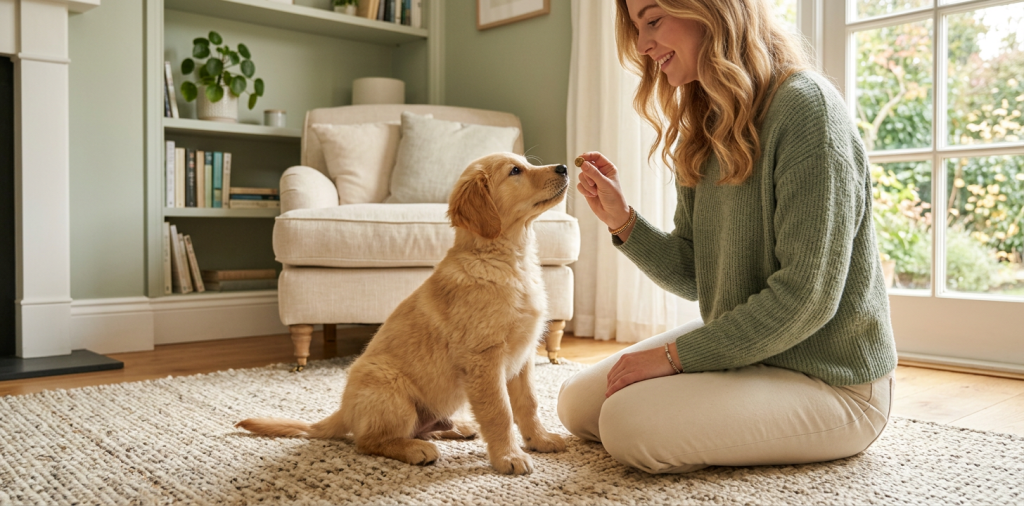
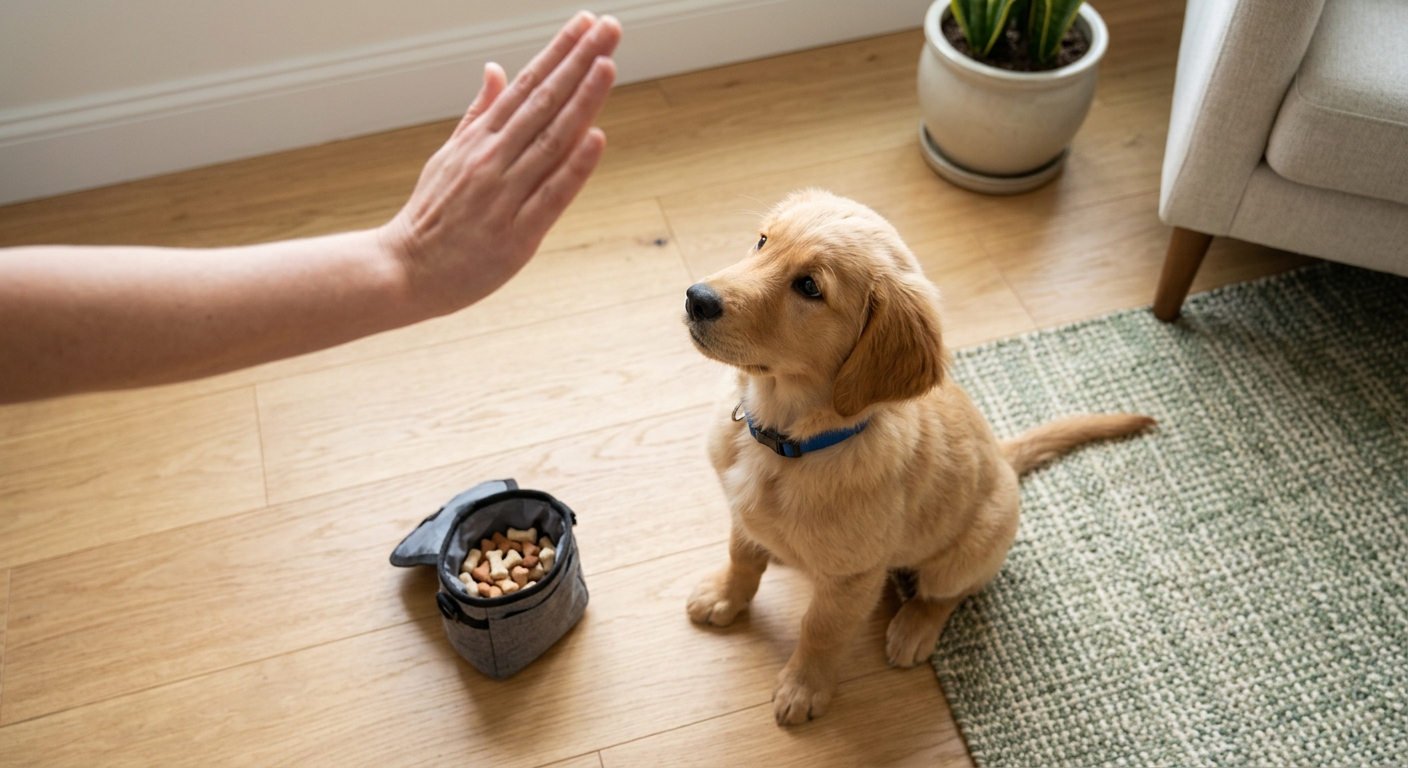
Using a lure is usually the clearest first method because it helps your puppy discover the movement without pressure. The treat guides the puppy’s nose upward and back, which naturally encourages the rear end to touch the floor.
Follow These Simple Steps
- Hold a treat directly in front of your puppy’s nose.
- Slowly move the treat upward and slightly back over the puppy’s head. Keep it close enough that your puppy can follow it without jumping.
- The instant your puppy’s bottom touches the ground, say your marker word, then give the treat.
- Allow your puppy to stand or take a few steps, then repeat.
- After a few successful repetitions, say “sit” just before you make the hand motion.
The timing matters more than the volume of your voice. Your puppy needs to connect the cue, the physical action, and the reward in the correct order.
If your puppy backs away, your hand is probably too high or too far behind their head. If they jump, move the treat more slowly and keep it closer to the nose. A brief pause is fine, but avoid repeating “sit, sit, sit.” Say the cue once, then help your puppy succeed or reset calmly.
The AKC’s basic cue training instructions also recommend phasing out the food lure after only a few repetitions. Your empty hand should become the signal, while the reward still arrives after the behavior.
Teach the Word Only After the Movement Makes Sense
Your puppy should learn that “sit” predicts an action, not that the word is background noise. Add the verbal cue only when your puppy is already following the hand signal smoothly.
Say “sit” once, wait about a second, then make the same hand motion. Mark and reward when the puppy sits. After several successful tries, begin making your hand signal smaller and less obvious.
This sequence prevents a common problem: puppies who respond beautifully to a visible treat but appear to ignore the word. The food is a teaching tool, not a permanent bribe. Once the behavior is familiar, the reward becomes payment for a job well done.
Use Capturing If Your Puppy Already Sits Often
Capturing is an excellent alternative for puppies who naturally sit near you. Keep treats nearby, wait quietly, and mark the exact moment your puppy chooses to sit. Then reward.
After several captured sits, begin saying “sit” as your puppy starts lowering their rear. This method can be especially useful for puppies who jump when they see food held above their head.
Day 7: Make Sit Useful in Everyday Puppy Life
By Day 7, your aim is not perfection. Your aim is to help your puppy understand that sitting politely works in real life, even when treats are not the only reward.
Use a simple seven-day progression:
- Days 1 and 2: Practice indoors with a food lure for a few successful repetitions.
- Days 3 and 4: Say the cue before the hand signal and reduce how much you move your hand.
- Days 5 and 6: Practice in two quiet locations, such as the kitchen and backyard.
- Day 7: Ask for a sit before pleasant daily events.
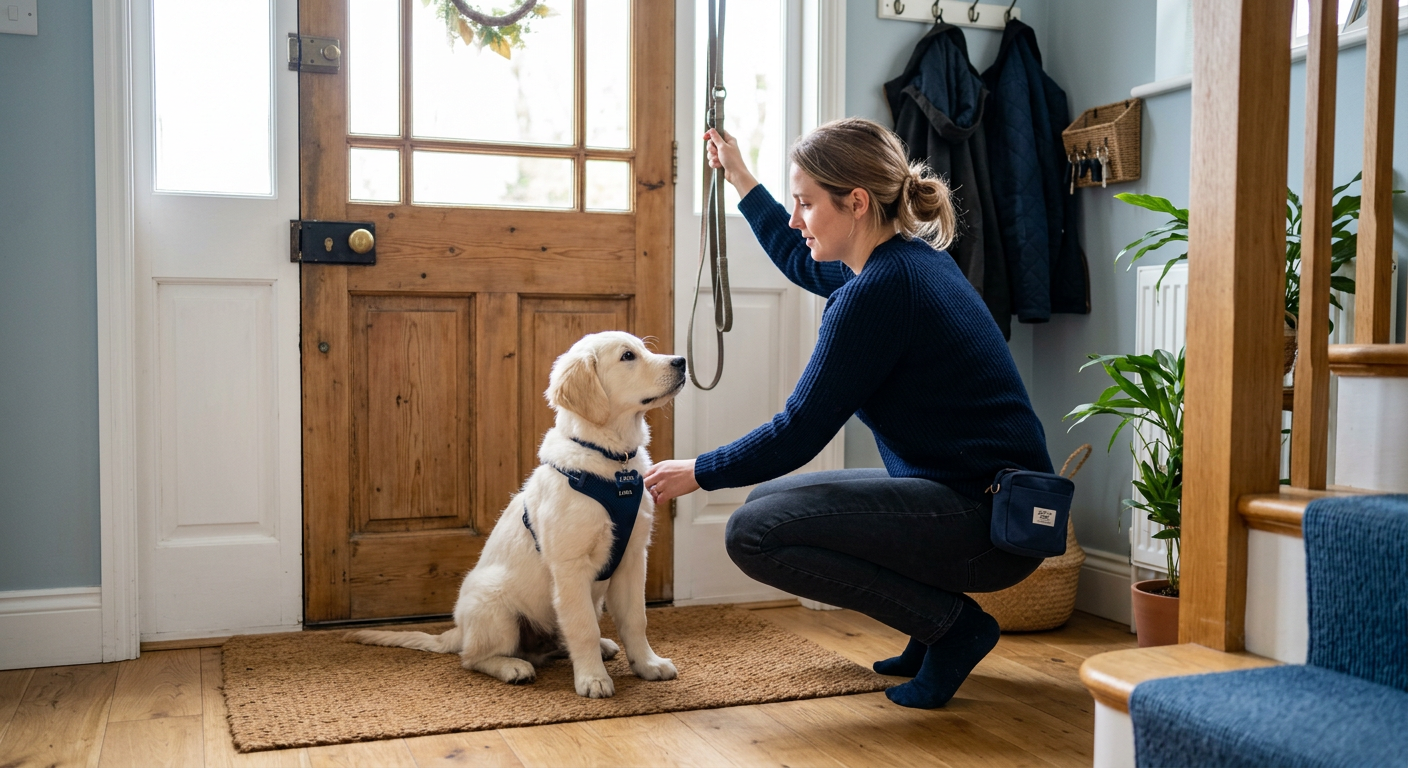
On Day 7, ask for a sit before clipping on the leash, placing down the food bowl, opening the door for a backyard break, or greeting a familiar person. If your puppy sits, the activity itself becomes part of the reward.
This approach makes the cue practical rather than performative. A puppy who learns to sit before good things happen is practicing self-control in small, realistic moments. For another useful next step, the AKC’s advice on teaching a place cue can help you build calm behavior when guests arrive or dinner is being prepared.
Solve the Most Common Sit-Training Problems
Most sit-training setbacks come from a mismatch between the puppy’s current skill level and the situation. Lower the difficulty, improve your timing, and focus on one clear repetition at a time.
Your Puppy Jumps Instead of Sitting
Keep the treat lower and move it more slowly toward the forehead rather than lifting it high above the head. Reward four paws on the floor first if jumping has become a habit, then build toward the sit.
Your Puppy Lies Down Instead
You may be moving the treat too far back. Bring your hand forward slightly so your puppy lifts their head without folding into a down position. Reward the smallest improvement rather than waiting for a perfect response.
Your Puppy Sits Only When You Have a Treat
Practice with an empty hand, then reach into your treat pouch after the sit. This teaches your puppy that rewards can appear after the cue, not only when the food is visible beforehand.
Your Puppy Ignores You Outside
That does not mean the puppy is stubborn. It usually means the environment is too difficult. Move farther from distractions, use a more valuable reward, and practice where your puppy can succeed before expecting a response on a busy sidewalk.
Reward Well, Then Reduce Treats Gradually
Food rewards are useful during learning, but a strong sit does not require treating every repetition forever. Once your puppy responds consistently in an easy setting, begin mixing in praise, toys, access to sniffing, play, or permission to move forward.
We recommend a gradual shift rather than abruptly removing treats. Reward every correct sit while the skill is new. Later, reward some sits with food and others with life rewards, while continuing to praise the behavior.
Reward-based training is about more than snacks. It teaches your puppy that cooperation leads to good outcomes, and it gives you a calm alternative to jumping, barking, or rushing through doorways.
Questions Puppy Owners Often Ask
What age can we start teaching a puppy to sit?
We can begin simple reward-based learning when a puppy comes home, provided the session is brief and age-appropriate. Very young puppies may have short attention spans, so prioritize a few happy repetitions over a formal lesson.
How long does it take for a puppy to learn sit?
Many puppies understand the basic motion within a few short sessions, but reliability takes longer. Expect steady practice across different rooms, people, and distraction levels before treating the cue as dependable.
Should we use a clicker to teach sit?
A clicker can work well, but it is optional. A consistent marker word such as “yes” can serve the same purpose when it is delivered at the exact moment your puppy sits.
What if our puppy will not take treats during training?
Your puppy may be too excited, nervous, full, or distracted to eat. Move to a quieter space, try training before a meal with part of the puppy’s regular food, or use a reward your puppy finds more appealing.
Is it okay if our puppy sits crookedly?
An occasional crooked sit is common, especially in a growing puppy. If you notice repeated asymmetry, reluctance to sit, yelping, or stiffness, pause training and discuss it with your veterinarian.
Do we need both a hand signal and a verbal cue?
Using both is helpful because it gives your puppy two clear ways to understand the request. Many dogs respond to hand signals very well, while a verbal cue is especially useful when your hands are occupied.
Build More Calm, Confident Puppy Habits
A sit may look simple, but it can become the starting point for polite greetings, leash manners, waiting at doors, and learning to settle. Explore more practical pet-care routines and everyday well-being ideas at Content Beast to keep building skills that fit real life with a puppy.
A Calm Sit Starts With Clear Communication
The best answer to how to teach a puppy to sit is to make the behavior easy, rewarding, and repeatable. Begin in a quiet room, mark the instant the rear touches the floor, add the cue after your puppy understands the movement, and bring the skill into daily routines a little at a time.
Progress is not measured by how quickly your puppy performs on the first day. It is measured by a growing pattern of calm, willing responses, built through clear communication and many small successes.