
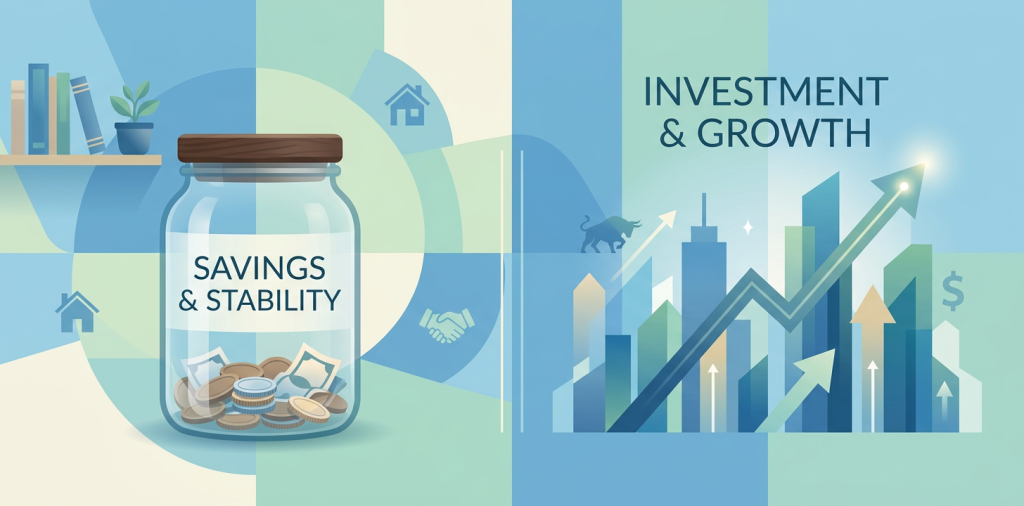
Most money mistakes don’t happen because people choose a “bad” option. They happen because they use the right option for the wrong job, like putting next month’s rent into the stock market or letting retirement money sit in cash for years.
That’s where high yield savings account vs index fund decisions get interesting. Both can be smart. Both can grow your money. But they solve very different problems, and mixing them up can cost you either safety or long-term growth.
Here’s the thing: you don’t have to pick one forever. The smarter move is knowing which dollars belong in cash, which dollars belong in the market, and when to use both.
High Yield Savings Account vs Index Fund at a Glance
| Feature | High Yield Savings Account | Index Fund |
|---|---|---|
| Best For | Short-term cash | Long-term growth |
| Risk Level | Very low | Market risk |
| Return Type | Interest | Investment returns |
| Access | Fast withdrawals | Sell shares first |
| Protection | FDIC insured if eligible | Not FDIC insured |
A high yield savings account is usually the better home for money you need soon. An index fund is usually the better tool for money you can leave invested for years.
That simple split answers most of the confusion.
What a High Yield Savings Account Actually Does
A high yield savings account, often called an HYSA, is a bank savings account that pays a higher interest rate than a traditional savings account. Your balance earns interest, and your money generally stays easy to access.
The biggest benefit is stability. If your account is at an FDIC-insured bank, the FDIC says deposit insurance generally covers up to $250,000 per depositor, per insured bank, for each ownership category through its deposit insurance guidance.
That doesn’t mean every account is automatically perfect. You still want to check fees, withdrawal limits, minimum balances, transfer speed, and whether the advertised annual percentage yield is temporary.
Best Uses for a High Yield Savings Account
Use a high yield savings account for money that needs to be boring, safe, and ready.
Good examples include:
- Emergency funds
- Rent, mortgage, or tax money
- A vacation planned within the next year
- A down payment you’ll need soon
- Pet emergencies, medical deductibles, or car repairs
- Cash you’re holding before making a planned purchase
If losing 20% right before you need the money would create stress, it probably doesn’t belong in an index fund yet.
What an Index Fund Actually Does
An index fund is a mutual fund or exchange-traded fund designed to track a market index, such as the S&P 500, a total U.S. stock market index, or a bond index. Instead of trying to pick winning stocks, it aims to mirror a broad basket of securities.
The U.S. Securities and Exchange Commission’s Investor.gov explains that index funds generally follow a passive style and may have lower costs, although investors should still check fees and understand risks before investing through its index fund guide.
The upside is long-term growth potential. The downside is volatility. Your balance can fall, sometimes sharply, and it may take time to recover.

Best Uses for an Index Fund
Index funds usually make sense for goals with longer timelines.
Common examples include:
- Retirement investing
- Building wealth over 10 or more years
- College savings when the child is still young
- Long-term taxable brokerage investing
- Financial independence goals
The longer your time horizon, the more time you may have to ride through market dips. That’s why index funds are often discussed as wealth-building tools, not cash-storage tools.
The Risk Difference Matters More Than the Return Difference
When people compare a high yield savings account vs index fund, they usually focus on returns first. That’s understandable, but risk should come first.
A savings account protects principal when properly insured, but interest rates can change. An index fund offers more growth potential, but it can lose value in any given month or year.
A useful rule of thumb is this: if you need the money within three years, lean toward cash. If you don’t need it for seven to ten years or more, investing becomes easier to justify.
That middle zone, around three to seven years, is where personal judgment matters. You might use a mix, such as keeping the must-have amount in savings and investing only the extra cushion.
The Return Difference Can Be Huge Over Time
A high yield savings account can feel great when rates are attractive. You earn interest without watching the market bounce around. For short-term money, that’s a win.
But cash has a ceiling. Over long periods, inflation can eat away at purchasing power, and savings account yields may fall when interest rates decline.
Index funds can be much more powerful over decades because market returns can compound. They also come with uncomfortable years, which is the emotional price of higher expected returns.
One reason index funds remain popular is that active managers often struggle to beat broad benchmarks. In the SPIVA U.S. Year-End 2025 report, S&P Dow Jones Indices found that 79% of active large-cap U.S. equity funds underperformed the S&P 500 in 2025.
That doesn’t prove every index fund will perform well, and it doesn’t remove market risk. It does show why many long-term investors prefer broad, low-cost exposure instead of trying to pick winners.
When a High Yield Savings Account Is the Better Choice
Choose a high yield savings account when the job is safety, access, and certainty.
It’s the better fit if:
- You’re building an emergency fund
- You’ll need the money in the next few months or years
- You can’t afford a market loss
- You’re saving for a known bill
- You’re preparing for a major life change
Think about a health-focused reader saving for a surgery deductible, a pet owner keeping cash for an emergency vet visit, or a family planning a move. The goal isn’t maximum return. The goal is making sure the money is there when life happens.
When an Index Fund Is the Better Choice
Choose an index fund when the goal is long-term growth and you can tolerate short-term swings.
It’s the better fit if:
- You’re investing for retirement
- Your timeline is long
- You already have emergency savings
- You’re comfortable with market ups and downs
- You want broad diversification
This is where mindset matters. If you panic every time the market drops, even a good index fund can become a bad experience. The best investment is one you can realistically stick with.
Why Many People Need Both
The best financial plan usually doesn’t ask, “Which one wins?” It asks, “What job does each dollar have?”
Your emergency fund might live in a high yield savings account. Your retirement contributions might go into index funds. Your next vacation fund might stay in cash, while your future wealth-building money gets invested monthly.
This creates a balanced system. Cash helps you sleep at night, and investments help your future self.
A Simple Allocation Framework
Try this practical order:
- Keep one month of expenses in checking or savings.
- Build three to six months of emergency savings in a high yield savings account.
- Pay down high-interest debt.
- Invest for retirement through tax-advantaged accounts when available.
- Use taxable index funds for additional long-term goals.
You can adjust the order based on your life. A freelancer may want more cash. A person with stable income and low expenses may invest more aggressively.
Common Mistakes to Avoid
The first mistake is investing your emergency fund. A market downturn and a job loss can happen at the same time, which is exactly when you don’t want to sell investments at a loss.
The second mistake is keeping all your long-term money in savings. Safety feels good, but if your timeline is 20 or 30 years, too much cash can quietly limit your future purchasing power.
The third mistake is chasing rates or returns without a plan. A higher savings APY is nice, and a hot market year feels exciting, but your goals should drive the account choice.
Frequently Asked Questions
Is a high yield savings account safer than an index fund?
Yes, for principal protection, a high yield savings account is generally safer when held at an FDIC-insured bank within coverage limits. An index fund can lose value because it holds market-based investments.
Can you lose money in a high yield savings account?
You typically won’t lose principal in an insured savings account within FDIC limits, but your interest rate can change. You can also lose purchasing power if inflation is higher than your account yield.
Can you lose money in an index fund?
Yes. Index funds rise and fall with the securities they track. Over long periods they may offer growth potential, but short-term losses are normal.
Which is better for an emergency fund?
A high yield savings account is usually better for an emergency fund because the money stays accessible and stable. Emergency cash should be reliable, not exposed to market swings.
Which is better for retirement?
Index funds are often better suited for retirement because retirement usually has a long timeline. Many investors use diversified stock and bond index funds inside retirement accounts.
Should I invest before I finish my emergency fund?
It depends on your income stability, debt, and risk tolerance. Many people build at least a small cash cushion first, then invest while continuing to grow emergency savings.
How much should I keep in savings before investing?
A common target is three to six months of essential expenses. If your income is irregular, your job is less stable, or you support dependents, you may want more.
Build Smarter Money Habits With ContentBeast
If you like practical, plain-English financial explainers, explore more helpful guides at ContentBeast. You’ll find approachable content across personal finance, health, pet care, happiness, habits, and everyday decision-making.
The Bottom Line on Choosing the Right Account
The high yield savings account vs index fund debate isn’t really a contest. It’s a matching exercise.
Use a high yield savings account for money you need to protect and access soon. Use index funds for money you want to grow over the long run and can leave alone through market swings.
When you give each dollar the right job, your financial life gets calmer. You stop guessing, stop chasing, and start building a system that actually fits your real life.